Sunday, August 14, 2011
Singularity Hub

While robots aren’t ready to carry the burden of being a soldier, they are more than able to carry their load. Lockheed Martin’s Squad Mission Support System (SMSS) is a 11 foot long, two ton, six-wheeled autonomous vehicle that can carry 1200 pounds of cargo up to 125 miles, and it’s going to be in Afghanistan along side active soldiers this year! Its advanced sensors and autonomous behavior allow it to follow preplanned paths, travel to way points, or just trail behind a human like 3800 pounds of infatuated puppy. The SMSS will allow ground troops to travel farther with less fatigue, but that’s just the beginning. In the future, vehicles like the SMSS could hold the key to completely unmanned supply lines and support systems. Check out videos of the autonomous rover in action below. Ready to join the thousands of ground robots already in Afghanistan, the SMSS is the latest sign that the modern US military relies on a balanced team of man and machine.
The SMSS is all about augmenting the capabilities of ground troops. US soldiers can carry a heavy load of weapons and supplies into combat, wearing them down and slowing their movement. With the SMSS carrying that equipment, soldiers can go farther and have more energy when they arrive at their destination. Also, the SMSS can be loaded with additional supplies for each mission, whether that’s food, heavy weapons, or even other robots. The following video highlights how the SMSS can operate with supervised autonomy or remote control, but the vehicle is also equipped to be driven manually...[Full Article]
Labels: Afghanistan, military, robotics


Monday, February 28, 2011
NY Daily News


A Massachusetts engineering firm known for creating futuristic military robots has received multimillion dollar contracts to develop two more battlefield bots for the Department of Defense.
Boston Dynamics, which in 2008 unveiled a four-legged robot called BigDog, has been tapped by the Defense Advanced Research Projects Agency (DARPA), the research and development arm of the DOD, to create a human-like robot and an agile, robotic Cheetah that developers said will eventually be able to run 70 mph.
WATCH VIDEO OF THE BIGDOG BELOW
The human-like bot, Atlas, will have two arms and legs, but no head, and be able to walk and jog upright, climb, squeeze through narrow alleyways and use its hands, Boston Dynamics said.
The Terminator-like droid would represent a step forward from Boston Dynamic's current anthropomorphic robot, known at PETMAN, which is used to test chemical weapons protection suits for the Army.
WATCH VIDEO OF THE PETMAN BELOW
[Full Article]Labels: DARPA, Defense Department, Department of Defense, robotics, robots
Sunday, September 12, 2010
It sounds like something straight out of Stanley Kubrick’s 2001: A Space Odyssey.
But, in a chilling echo of the computer Hal from the iconic film, scientists have developed robots that are able to deceive humans and even hide from their enemies.
An experiment by researchers at the Georgia Institute of Technology is believed to be the first detailed examination of robot deception.
The team developed computer algorithms that would let a robot ‘decide’ whether it should deceive a human or another robot and gave it strategies to give it the best chance of not being found out...
[Full Article]Sunday, August 1, 2010
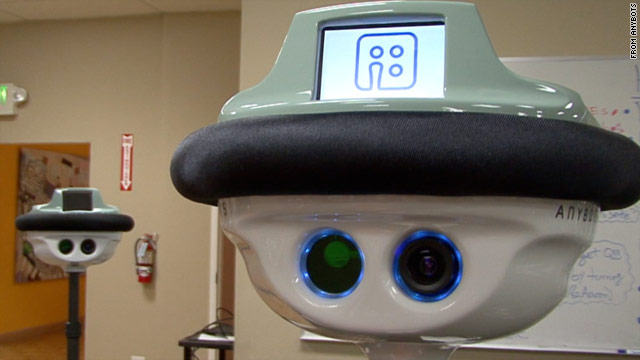
(CNN) -- When Trevor Blackwell, CEO of a company called Anybots, wants to know what his employees are up to, he sends a robot to their cubicles.
"I can see if people are busy on something -- and then won't interrupt them," he said this week. "Or, you know, if they're doing something that looks interesting, or if they look stuck, I'll have a conversation with them."
This isn't your standard "Office Space" conversation. Blackwell boots up a "telepresence robot" -- which looks like a combination between a Segway and Johnny 5 from those "Short Circuit" movies -- to talk to his employees from his home, 10 miles from Anybots' office in Mountain Home, California.
The 5-foot-6, 35-pound robot contains a video camera, a still camera and a microphone. From a laptop, Blackwell can see everything the robot sees. He hears what the robot hears. And, when he talks, the robot projects his voice.
He drives the robot, called QB, with his computer keyboard. A sensor stops it from running into doors and tables. The robot zips around at 3.5 miles per hour, and its battery lasts up to 8 hours, or the length of a typical human workday, he said.
Watch the company's demo video, and this will all make more sense
Blackwell says that this is how the office of tomorrow will work. Within a year or so, he says, every office in Silicon Valley, California, will have about one telepresence robot for every 10 employees...
[Full Article]Labels: big brother, privacy, robot, robotics, robots, spying
Wednesday, June 30, 2010
Pentagon research scientists have taken a first step towards "Transformers"-style shape-shifting cars and aircraft, with a robot that can fold itself like origami into different forms.
At the moment the tiny robot - a sheet just half a millimetre thick, scarcely thicker than a piece of paper - only folds itself into a boat, like a child's toy, or a "paper glider" plane shape. But it is anticipated that in future it will be used to create full-sized cars and aircraft that morph as they move, or robots that can "flow" like mercury into small openings, or multipurpose military uniforms that can adapt to different environments.
Researchers at the Pentagon's Defense Advanced Research Projects Agency (Darpa) launched the project in 2007 in conjunction with Harvard and the Massachusetts Institute of Technology. It is a small sheet of stiff tiles and "joints" of elastomer, “studded with thin foil actuators and flexible electronics. The demonstration material contains 25 total actuators, divided into five groupings. A shape is produced by triggering the proper actuator groups in sequence,” according to a statement by Robert Wood, the head of the Harvard research team...
Labels: DARPA, Pentagon, robotics
Sunday, May 16, 2010
TOKYO (AP) - Almost everyone stood when the bride walked down the aisle in her white gown, but not the wedding conductor, because she was bolted to her chair.
The nuptials at this ceremony were led by "I-Fairy," a 4-foot (1.5-meter) tall seated robot with flashing eyes and plastic pigtails. Sunday's wedding was the first time a marriage had been led by a robot, according to manufacturer Kokoro Co...
[Full Article]
Labels: robot, robotics, wedding
Thursday, May 13, 2010
Researchers from Columbia University, Arizona State University, the University of Michigan and the California Institute of Technology (Caltech) have created and programmed robots the size of single molecule that can move independently across a nano-scale track. This development, outlined in the May 13 edition of the journal Nature, marks an important advancement in the nascent fields of molecular computing and robotics, and could someday lead to molecular robots that can fix individual cells or assemble nanotechnology products...
[Full Article]
Labels: nanotechnology, robotics
Wednesday, May 12, 2010
For the first time, microscopic robots made from DNA molecules can walk, follow instructions and work together to assemble simple products on an atomic-scale assembly line, mimicking the machinery of living cells, two independent research teams announced Wednesday.
These experimental devices, described in the journal Nature, are advances in DNA nanotechnology, in which bioengineers are using the molecules of the genetic code as nuts, bolts, girders and other building materials, on a scale measured in billionths of a meter. The effort, which combines synthetic chemistry, enzymology, structural nanotechnology and computer science, takes advantage of the unique physical properties of DNA molecules to assemble shapes according to predictable chemical rules.
Until now, such experiments had yielded molecular novelties, from smiley faces so small that a billion can fit in a teaspoon to molecule-size boxes with lids that can be opened, closed and locked with a DNA key.
These new construction projects bring researchers a step closer to a time when, at least in theory, scientists might be able to build test-tube factories that churn out self-assembling computers, rare chemical compounds or autonomous medical robots able to cruise the human bloodstream...
Saturday, May 8, 2010

Robotics and prosthetics designers have been making great advances in the power, sensitivity and humanity of their creations.
Case in point: The i-Limb Pulse is a new bionic arm that allows users to handle heavy objects or delicate items, as well as customize the grips to fit their needs.
With a design similar to Darth Vader’s bionic hand, this is one tough prosthetic device.
The maker, Touch Bionics, claims this prosthetic hand can handle more than 200 pounds, if your biceps are up to it. When grabbing an object, it can apply additional force by using a pulsing effect...
Read More http://www.wired.com/gadgetlab/2010/05/new-bionic-arms/#ixzz0nNf5wYu1(From BBC News)
A future in which robots help around the home could prove harmful to humans, suggests a study.
German researchers studied what happens in accidents involving robots using sharp tools alongside humans.
They used a robot arm holding a variety of bladed tools programmed to strike test substances that mimic soft tissue.
In some cases, the researchers found, the robots managed to accidentally inflict wounds that would prove "lethal".
The tests were conducted to see if a prototype safety system could limit the damage done.
Human subjectThe tests involved a robot arm weighing 14kg and a 1.1m reach that was equipped with a variety of bladed household tools including a steak knife, kitchen knife, scissors and screwdriver.
The robot arm was programmed to use the bladed tools to stab and cut a silicone lump, a leg from a dead pig and the arm of a human volunteer.
Striking, stabbing and puncturing tests with the safety system turned off were performed on the silicone and pig leg. Deep cuts resulted in most cases that, the researchers said, could prove to be "lethal" if inflicted on a living subject.
Three researchers from the Institute of Robotics and Mechatronics at the German aerospace agency wanted to carry out the tests because they envisage a future in which robots will start to become domestic helpers.
Injuries were significantly reduced when the prototype collision detection system developed by the trio was switched on. This system uses torque sensors to spot when it has hit a different substance and halts movement. It was used to limit damage when human subjects were tested.
Previous studies have looked at what would happen when large heavy robots bump into people. However, the German study is thought to be the first to look at the slashing injuries robots could cause.
The results of the study were presented at the 2010 IEEE International Conference on Robotics and Automation, held in Alaska in early May.
Tuesday, April 27, 2010


Cory Kidd, CEO of Intuitive Automata, poses at his office in Hong Kong next to a robot he designed as a dietary assistant. Users can have daily conversations with the 38-centimetre-tall (15-inch) robot, which will crunch calories and provide feedback and encouragement on their weight-loss progress.
AFP - Imagine something between a computer game and a pet that helps makes you slim. One inventor did just that and came up with Autom -- a robot that will look dieters in the eye and tell them what they need to hear.
Users can have daily conversations with the 38-centimetre-tall (15-inch) robot, which will crunch calories and provide feedback and encouragement on their weight-loss progress.
For those who hate manuals -- there isn't one. Switch Autom on and it's ready to go.
Its blue eyes open and its head swivels as a computer inside its head allows it to search for a human face in front of it and maintain eye contact.
"Hello, I'm Autom! Press one of the buttons below to talk to me," it says in a robotic female voice with an American accent. "I'm ready to get started. Let's keep working together."...
..."You'll see a lot of changes in the next few years. In 30 years this is going to look very primitive," he said.
"Technology has really advanced in the last decade to allow us to finally create something like this. A lot of what goes into this would 10 years ago have not been possible. Five years ago it would not have been feasible and two years ago it would not have been affordable."
Kidd's company Intuitive Automata is based in Hong Kong and Autom also speaks Chinese -- both Cantonese and Mandarin.
Initially, though, the company will use an English-language version to target the United States, where the government estimates two-thirds of the population is overweight or obese, followed by Europe.
Kidd is confident the model can be adapted to different languages and cultures as well as other health issues -- chronic disease management, diabetes, even drug and alcohol abuse.
The UN Economic Commission and the International Federation of Robotics forecast a market for personal and service robots worth about 52 billion US dollars by 2025.
Labels: Automata, Cory Kidd, robotics
Friday, February 12, 2010
Illustrating once again that the prison planet being built around us far outstrips anything Aldous Huxley or George Orwell ever imagined, a Wired News report details how police forces worldwide are preparing to unveil drone aircraft that can not only conduct surveillance of protesters, but also zap them into submission with non-lethal weapons...
Labels: drones, robot, robotics
Police forces all over the UK will soon be able to draw on unmanned aircraft from a national fleet, according to Home Office plans. Last month it was revealed that modified military aircraft drones will carry out surveillance on everyone from protesters and antisocial motorists to fly-tippers, and will be in place in time for the 2012 Olympics.
Surveillance is only the start, however. Military drones quickly moved from reconnaissance to strike, and if the British police follow suit, their drones could be armed -- but with non-lethal weapons rather than Hellfire missiles...
Labels: drones, robot, robotics, UK, United Kingdom
Saturday, January 23, 2010
"You can't appeal to robots for mercy or empathy - or punish them afterwards"
In the dark, in the silence, in a blink, the age of the autonomous killer robot has arrived. It is happening. They are deployed. And – at their current rate of acceleration – they will become the dominant method of war for rich countries in the 21st century. These facts sound, at first, preposterous. The idea of machines that are designed to whirr out into the world and make their own decisions to kill is an old sci-fi fantasy: picture a mechanical Arnold Schwarzenegger blasting a truck and muttering: "Hasta la vista, baby." But we live in a world of such whooshing technological transformation that the concept has leaped in just five years from the cinema screen to the battlefield – with barely anyone back home noticing...
Labels: robotics, technology, warfare
Sunday, January 10, 2010
LAS VEGAS, Nevada — Billed as a world first, Roxxxy the sex robot made here debut in front of adoring fans at the AVN Adult Entertainment Expo in Las Vegas.
The life-size robotic girlfriend comes complete with complete with artificial intelligence and flesh-like synthetic skin...
Labels: artificial intelligence, robotics

Subscribe to Posts [Atom]