Thursday, August 4, 2011
Kurt Nimmo
InfoWars.com
August 4, 2011
Cofer Black, veteran CIA spook and former vice chairman of the mercenary outfit Blackwater, sees parallels between the terrorism threat that emerged before the September 11 attacks nearly ten years ago and the emerging cyber threat we supposedly confront now, according to Reuters.
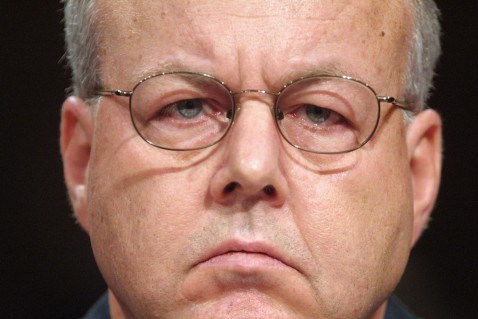
Black worked nearly 30 years for the Directorate of Operations at the CIA, now known as the National Clandestine Service. As former CIA employee John Stockwell noted, the unit has “engineered covert action operations in virtually every corner of the globe,” resulting in violent coups and countless people killed. In 2007, it was revealed that more than 50 percent of the National Clandestine Service has been outsourced to private firms.
Black mounted the stage at a Black Hat conference in Las Vegas to make his prediction. “Your world, which everyone thought was college pranks … has morphed into physical destruction,” he told the nearly 6,000 hackers and security professionals at the conference, reports the Wall Street Journal. “Guess what: It is your turn whether you know it or not.”
Black’s comments fall on the heels of a suggestion by former CIA and NSA boss Michael Hayden that a “digital Blackwater” may be required to combat the threat of cyber terrorism.
“We may come to a point where defense is more actively and aggressively defined even for the private sector and what is permitted there is something that we would never let the private sector do in physical space,” Hayden said. “Let me really throw out a bumper sticker for you: how about a digital Blackwater?”
Cofer Black also said the cave-dwelling terror group al-Qaeda will go cyber. “They will enter the cyber world because it’s comparatively remote, comparatively safer than strapping on a bomb,” he said.
Black’s prediction follows a report issued by the British Home Office claiming al-Qaeda has launched a “cyber jihad.”
Last month, Deputy Secretary of Defense William Lynn III said it was “clear” terror groups were “intent on acquiring, refining, and expanding their cyber capabilities.”
Black cited the Stuxnet virus during his speech to Black Hat Linux geeks. “The Stuxnet attack is the Rubicon of our future… Your world, which people thought was college pranks cubed and squared, has now morphed into physical destruction… from the victim’s view, of a national resource. This is huge.”
Stuxnet shut down centrifuges critical to Iran’s uranium processing. The now infamous malware described as the world’s first cyber weapon was jointly developed by the United States and Israel. Unnamed sources at Israel’s Dimona nuclear complex admitted earlier this year that the sophisticated malware was developed in Israel over the last two years as part of a joint US-Israeli operation designed to sabotage Iran’s nuclear program.
In April of 2001, Black told a class at a military college that “something big” would happen in the United States. He later told a congressional inquiry into the 9/11 attacks that during the spring and summer of that year he “became convinced that al-Qaeda was going to strike hard.”Labels: cyber attack, Kurt Nimmo


Saturday, January 29, 2011
(CNN) -- FBI agents have executed 40 search warrants throughout the United States as part of an investigation into recent coordinated cyber attacks targeting major companies, the agency said.
The United Kingdom's Metropolitan Police Service executed additional search warrants and arrested five people for their alleged role in the attacks, the FBI said in a statement Thursday.
A group calling itself "Anonymous" has claimed responsibility for the attacks, the FBI said. The attacks were allegedly carried out by people who are active supporters of WikiLeaks, but are not affiliated with the website, a federal law enforcement source said...
[Full Article]Labels: cyber attack, FBI, Federal Bureau of Investigation
Thursday, July 22, 2010
Billion dollar cybersecurity industry at the forefront of ‘Top Secret America’ complex
Steve Watson
Prisonplanet.com
Wednesday, Jul 21st, 2010
 An increasing clamour to restrict and control the internet on behalf of the government, the Pentagon, the intelligence community and their private corporate arms, could result in a staged cyber attack being used as justification.
Over recent months we have seen a great increase in media coverage of inflated fears over a possible “electronic Pearl Harbor” event, with reports claiming that the U.S. could be “felled within 15 minutes”.
Vastly over-hyped (and in some cases completely asinine) claims that the power grids and other key infrastructure such as rail networks and water sources are wired up to the public internet have permeated such coverage.
Threats against computer networks in the United States are grossly exaggerated. Dire reports issued by the Defense Science Board and the Center for Strategic and International Studies “are usually richer in vivid metaphor — with fears of ‘digital Pearl Harbors’ and ‘cyber-Katrinas’ — than in factual foundation,” writes Evgeny Morozov, a respected researcher and blogger who writes on the political effects of the internet.
Morozov notes that much of the data on the supposed cyber threat “are gathered by ultra-secretive government agencies — which need to justify their own existence — and cyber-security companies — which derive commercial benefits from popular anxiety.”
When the Cybersecurity Act was introduced by Senator John Rockefeller last year, he made similar claims about the threat of cyber attacks, adding “Would it have been better if we’d have never invented the Internet?”.
Rockefeller’s legislation gives the president the ability to “declare a cybersecurity emergency” and shut down or limit Internet traffic in any “critical” information network “in the interest of national security.” The bill does not define a critical information network or a cybersecurity emergency. That definition would be left to the president, according to a Mother Jones report.
Provisions in the bill would allow the federal government, via the DHS and the NSA, to tap into any digital aspect of every citizen’s information without a warrant. Banking, business and medical records would be wide open to inspection, as well as personal instant message and e mail communications – all in the name of heading off cyber attacks on the nation.
Enhancements of such provisions are contained in the more recent “Protecting Cyberspace as a National Asset Act”, which is being pushed hard by Senator Joe Lieberman. The bill would hand absolute power to the federal government to close down networks, and block incoming Internet traffic from certain countries under a declared national emergency.
An accompanying cybersecurity control grid would only create greater risk according to experts who note that it would essentially “establish a path for the bad guys to skip down.” Other countries, such as Australia and the UK are following suit.
The program dovetails with the Pentagon’s newly created Cyber Command, headed by Keith B Alexander, the acting head of the NSA and the man behind the massive program of illegal dragnet surveillance of domestic communications since at least 2001.
During the Senate Armed Services Committee confirmation hearing, Alexander said the Pentagon’s Cyber Command would enjoy “significant synergy” with the NSA. “We have to show what we’re doing to ensure that we comport, comply with the laws,” said Alexander, perversely claiming the agency is respecting and protecting the privacy of the American people.
The Pentagon considers cyberspace a warfighting domain equal to land, sea, air and space. In 2003, the Pentagon classified the internet as an enemy “weapons system” requiring a “robust offensive suite of capabilities to include full-range electronic and computer network attack.” It has spent Billions of dollars building a super secret “National Cyber Range” in order to prepare for “Dominant Cyber Offensive Engagement”, which translates as control over “any and all” computers. The program has been dubbed “The Electronic Manhattan Project”.
The enemy is never specifically named, it is merely whoever uses the net, because the enemy IS the net. The enemy is the freedom the net provides to billions around the globe and the threat to militaristic dominance of information and the ultimate power that affords.
These initiatives represent a continuation of the so called “Comprehensive National Cybersecurity Initiative”, created via a secret presidential order in 2008 under the Bush administration. former National Intelligence Director Mike McConnell announced that the NSA’s warrantless wiretaps would “be a walk in the park compared to this,”.
“This is going to be a goat rope on the Hill” McConnell said. My prediction is that we’re going to screw around with this until something horrendous happens.”
As we have previously reported, large corporations such as Google, AT&T, Facebook and Yahoo to name but a few are intimately involved in the overarching program. Those corporations have specific government arms that are supplying the software, hardware and tech support to US intelligence agencies in the process of creating a vast closed source database for global spy networks to share information.
Clearly the implications of this program for the open and free internet, and for liberty in general are very worrying, this has been reflected in the resistance and criticism from groups such as the Electronic Frontier Foundation.
In light of this, there is a real danger of a hyped or completely staged cyber attack being propagated in order to bring the issue to public attention and counter the critics who have exposed it as a part of the agenda to restrict the Internet.
In 2008 Stanford Law professor Lawrence Lessig detailed such ongoing government plans for overhaul and restriction.
Lessig told attendees of a high profile Tech conference that “There’s going to be an i-9/11 event” which will act as a catalyst for a radical reworking of the law pertaining to the internet.
Lessig said that he came to that conclusion following a conversation with former government Counter Terrorism Czar Richard Clarke, who informed him that there is already in existence a cyber equivalent of the Patriot Act, an “i-Patriot Act” if you will, and that the Justice Department is just waiting for a cyber terrorism event in order to implement its provisions.
Lessig is the founder of Stanford Law School’s Center for Internet and Society. He is founding board member of Creative Commons and is a board member of the Software Freedom Law Center. He is best known as a proponent of reduced legal restrictions on copyright, trademark and radio frequency spectrum, particularly in technology applications.
These are clearly not the ravings of some paranoid cyber geek.
Though Richard Clarke advocates an enhancement of cyber security, even he has stated that it would be a terrible idea to allow the government to regulate and filter the internet.
We have also recently seen multiple mock attacks conducted by the government, via private outsourcing, on it’s own infrastructure systems. On such exercise, called “We Were Warned: Cyber Shockwave”, involved Former Department of Homeland Security secretary Michael Chertoff and former CIA deputy director John McLaughlin taking the roles of government leaders. CNN broadcast the entire simulation on prime time television.
Alex Jones recently discussed this issue on Russia Today news programming:
Journalist Webster Tarpley also lays out the hyping of cyber threats as a pretext to takedown the internet:
Labels: cyber attack, Steve Watson
Sunday, May 23, 2010
Pentagon creates specialist online unit to counter cyber attack amid growing fears of militarisation of the internet
The US military has appointed its first senior general to direct cyber warfare – despite fears that the move marks another stage in the militarisation of cyberspace.
The newly promoted four-star general, Keith Alexander, takes charge of the Pentagon's ambitious and controversial new Cyber Command, designed to conduct virtual combat across the world's computer networks. He was appointed on Friday afternoon in a low-key ceremony at Fort Meade, in Maryland.
The creation of America's most senior cyber warrior comes just days after the US air force disclosed that some 30,000 of its troops had been re-assigned from technical support "to the frontlines of cyber warfare".
The creation of Cyber Command is in response to increasing anxiety over the vulnerability of the US's military and other networks to a cyber attack.
James Miller, the deputy under-secretary of defence for policy, has hinted that the US might consider a conventional military response to certain kinds of online attack...
Labels: cyber attack, Cyberwarfare Command, Keith Alexander, Pentagon
Monday, April 26, 2010
WASHINGTON D.C.—Central Intelligence Agency director Leon Panetta told 300 Sacramento Metro Chamber Cap-to-Cap delegates that the next “Pearl Harbor” is likely to be an attack on the United States’ power, financial, military and other Internet systems.
Panetta addressed the Sacramento delegation that includes 43 elected officials and hundreds of business and civic leaders who are in Washington D.C. for the annual program that advocates for the region’s most pressing policy issues. He spoke on Monday, April 19, during the Cap-to-Cap opening breakfast.
“Cyber terrorism” is a new area of concern for the CIA, Panetta said. The United States faces thousands of cyber attacks daily on its Internet networks. The attacks are originating in Russia, China, Iran and from even hackers.
“The next Pearl Harbor is likely to be a cyber attacking going after our grid…and that can literally cripple this country,” Panetta said. “This is a whole new area of threat.”...
Labels: Central Intelligence Agency, CIA, cyber attack, Leon Panetta, Pearl Harbor
Wednesday, March 24, 2010
Goal is to have U.N. representative for cybersecurity policies, says Wall Street Journal
Computerworld - The U.S. is weighing the creation of an ambassador-level position for negotiating cybersecurity matters at the United Nations and for ensuring the country has a consistent international policy on the issue, according to the Wall Street Journal.
Both the U.S. State Department and Congress are considering the creation of such a role following the recent attacks on Google and numerous other high-tech companies, the Journal said, citing several unnamed sources. The proposals include a plan to develop policies tying foreign aid to a country's willingness and ability to fight cybercrime originating from within its borders...
Labels: cyber attack, cyber crime, cyber security, Internet, U.N., United Nations
FBI official warns about increasing cyber-sophistication of rogue states, criminals
Computerworld - WASHINGTON - A top FBI official warned today that many cyber-adversaries
of the U.S. have the ability to access virtually any computer system, posing a risk that's so great it could "challenge our country's very existence."
Steven Chabinsky, deputy assistant director of the FBI's cyber division, delivered a strong and urgent warning about the threat of cyberattacks during a presentation Tuesday at the FOSE government IT trade show here. Chabinsky also offered recommendations for countering the threat, including rules that would restrict the ability of some systems to interoperate with more vulnerable ones...
Labels: cyber attack, cyber crime, cyber security, FBI, Federal Bureau of Investigation, Internet
Sunday, March 21, 2010
It came as a surprise this month to Wang Jianwei, a graduate engineering student in Liaoning, China, that he had been described as a potential cyberwarrior before the United States Congress.
Larry M. Wortzel, a military strategist and China specialist, told the House Foreign Affairs Committee on March 10 that it should be concerned because “Chinese researchers at the Institute of Systems Engineering of Dalian University of Technology published a paper on how to attack a small U.S. power grid sub-network in a way that would cause a cascading failure of the entire U.S.”
When reached by telephone, Mr. Wang said he and his professor had indeed published “Cascade-Based Attack Vulnerability on the U.S. Power Grid” in an international journal called Safety Science last spring. But Mr. Wang said he had simply been trying to find ways to enhance the stability of power grids by exploring potential vulnerabilities...
Labels: China, cyber attack, cyber security, power grid
Tuesday, March 2, 2010
The biggest threat to the open internet is not Chinese government hackers or greedy anti-net-neutrality ISPs, it’s Michael McConnell, the former director of national intelligence.
McConnell’s not dangerous because he knows anything about SQL injection hacks, but because he knows about social engineering. He’s the nice-seeming guy who’s willing and able to use fear-mongering to manipulate the federal bureaucracy for his own ends, while coming off like a straight shooter to those who are not in the know.
Labels: cyber attack, cyber security, Internet
Saturday, February 27, 2010
The president would have the power to safeguard essential federal and private Web resources under draft Senate cybersecurity legislation.
According to an aide familiar with the proposal, the bill includes a mandate for federal agencies to prepare emergency response plans in the event of a massive, nationwide cyberattack.
Labels: cyber attack, cyber security, Internet
Wednesday, February 17, 2010
A simulated exercise titled “Cyber ShockWave” held by the Bipartisan Policy Center took place yesterday, February 16 at the Mandarin Oriental Hotel in Washington, D.C. The exercise was a simulated cyber-attack on the United States to see how well members of the government would respond to a large-scale cyber-attack on the nation's critical infrastructure. The participants were a group of former national security and administration officials from both the Democratic and Republican Party...
Labels: cyber attack, cyber security, Cyber ShockWave

Subscribe to Posts [Atom]