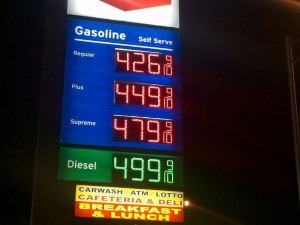
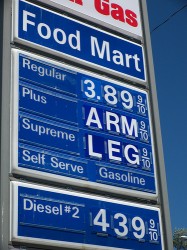
Does it cost you hundreds of dollars just to get to work each month? If it does, you are certainly not alone. There are millions of other Americans in the exact same boat. In recent years, the price of gas in the United States has gotten so outrageous that it has played a major factor in where millions of American families have decided to live and in what kind of vehicles they have decided to purchase. Many Americans that have very long commutes to work end up spending thousands of dollars on gas a year. So when the price of gas starts going up to record levels, people like that really start to feel it. But the price of gas doesn't just affect those that drive a lot. The truth is that the price of gas impacts each and every one of us. Almost everything that we buy has to be transported, and when the price of gasoline goes up the cost of shipping goods also rises. The U.S. economy has been structured around cheap oil. It was assumed that we would always be able to transport massive quantities of goods over vast distances very inexpensively. Once that paradigm totally breaks down, we are going to be in a huge amount of trouble. For the moment, the big concern is the stress that higher gas prices are going to put on the budgets of ordinary American families. Unfortunately, almost everyone agrees that in the short-term the price of gas is going to go even higher. (Read More....)
Gas prices could hit $4.50 a gallon nationwide by summer because of sanctions on Iran, a frigid winter in Europe, and logistical challenges in the US. The current all-time high is $4.11.
Christian Science Monitor
New York
Many drivers are already grumbling at gas prices this winter. But by this summer, Friday's AAA average of $3.58 a gallon for regular gasoline may look downright attractive.
Some energy analysts think gasoline on a national basis could climb into the $4.50 a gallon range. That would be above the all-time peak of $4.11 a gallon set on July 14, 2008. In some states such as California, Hawaii, and Alaska, prices are normally higher and could get closer to $5 a gallon.
“We are on track for a very expensive summer,” says Sander Cohan, a gasoline-market analyst and principal at Energy Security Analysis, Inc. in Wakefield, Mass...[Full Article]
NEW YORK (AP) -- Gasoline prices have never been higher this time of the year.
At $3.53 a gallon, prices are already up 25 cents since Jan. 1. And experts say they could reach a record $4.25 a gallon by late April.
"You're going to see a lot more staycations this year," says Michael Lynch, president of Strategic Energy & Economic Research. "When the price gets anywhere near $4, you really see people react...[Full Article]
Could prices at the gas pump reach $5 a gallon by Memorial Day? Experts on oil believe that projection is not unrealistic. Gas prices have already reached $4 in some parts of the country since the saber rattling over Iran started.
Speculation determines the actual price of gas, although we are told that it is based on supply and demand. In the United States analysts claim that production costs account for 68 percent of the price at the pump, refining 13 percent, distribution and marketing 7 percent and taxes 12 percent. However, speculators buy millions of barrels of oil at the auction floor and sell it as “futures,” betting that oil prices will rise. And they do. All that is needed is for the White House, Congress, the Pentagon and Wall Street to work together, creating crises the media can hype. Oil prices go up, speculators make a bundle, and all the 1 percenters are happy. On the other hand, we, the 99 percenters, are left “holding the pump.”...[Full Article]
Gasoline prices could soon hit $4 a gallon, a threshold they haven't flirted with since last spring.
The average price paid by U.S. drivers for a gallon of regular now stands at $3.52, according to the U.S. Energy Information Administration, which released its latest figures this afternoon. That price represents an increase of 0.04 percent from a week ago and 0.38 percent from a year ago.
Experts expect prices to spike another 60 cents or more, with the $4 mark being touched—or exceeded—sometime this summer, probably by Memorial Day weekend, the peak of the summer driving season. The last time the U.S. saw $4 gasoline was back in the summer of 2008...[Full Article]
The complaints that the St. John the Baptist Parish Sheriff's Office receives on a daily basis run the gamut from the mundane loud barking dog to the routine reports of speeders, to the make-you-shake-your head-and-say-what? calls about "my child is refusing to go to school."
But the call that came through on Thursday caught even veteran law enforcement officials off guard and perhaps created a new category: Way out of the ordinary.
But it also may be a sign of the times.
At 2 p.m. on Thursday, the St. John 9-1-1 emergency call center received a report from a motorist who became irate when, he said, a local gas station increased the price of the fuel - while he was filling up his truck.
The unidentified motorist told authorities that when he first pulled into the station at Birdie's Food and Fuel, located at 901 East Airline Highway in LaPlace, the price on the pump read $3.049 per gallon. But, while he was pumping, the price shot up to $3.189. The motorist confronted the station attendant but got no satisfaction, so he dialed 9-1-1...
One of the quickest ways to bring down the U.S. economy would be to dramatically increase the price of oil. Oil is the lifeblood of our economic system. Without it, our entire economy would come to a grinding halt. Almost every type of economic activity in this country depends on oil, and even a small rise in the price of oil can have a dramatic impact on economic growth. That is why so many economists are incredibly alarmed about what is happening in the Middle East right now. The revolution in Libya caused the price of WTI crude to soar more than 7 dollars on Tuesday alone. It closed at $93.57 on Tuesday and Brent crude actually hit $108.57 a barrel before settling back to $105.78 at the end of the day. Some analysts are warning that we could even see 5 dollar gas in the United States by the end of the year if rioting spreads to other oil producing nations such as Saudi Arabia. With the Middle East in such a state of chaos right now it is hard to know exactly what is going to happen, but almost everyone agrees that if oil prices continue to rise at a rapid pace over the next several months it is going to have a devastating impact on economic growth all over the globe...
U.S. oil prices look reassuringly calm till you look below the surface.
At first blush, a replay of the 2008 gas price spike seems far fetched. The biggest driver of U.S. gasoline prices is the cost of crude oil, and near-month oil futures on the New York Mercantile Exchange have sat out the scorching commodities rally. They lately fetched $85, some 40% below the crisis peak.
Food for unsettling thoughts
But that's where the good news ends for motorists -- and for a U.S. economy that is sputtering even with gas at $3.15 a gallon.
Much of the oil being made into gasoline now actually costs $105 a barrel. For this we can blame a few of the usual suspects – try Middle East unrest and strong overseas economic growth – and one new one, a weak link in the U.S. petroleum supply chain.
Those factors make the Nymex price "irrelevant for the price of U.S. gasoline," says Olivier Jacob, who runs the Petromatrix trading advice firm in Zug, Switzerland.
Even the government agrees. Last week it projected a 1-in-3 chance the gas price will break $3.50 this summer and a 1-in-10 chance it will hit $4. And if anything those estimates may understate how fragile the balance is.
"It would not take much" to send gas prices back to $4, says Jacob. Cold weather, Saudi reluctance to increase production and possible refinery outages could all play their part...
A former president of Shell Oil has predicted that Americans will be paying $5 for a gallon of gasoline by 2012. He blames growing global demand for oil, tighter supplies and inadequate responses by the U.S. government.
John Hofmeister made his comments during a taped interview Dec. 1, and it aired last weekend on Platts Energy Week television (www.plattsenergyweektv.com) an independent, all-energy news and talk show...
The scary thing is that Mr. Hofmeister is basing his $5 per gallon gasoline prediction on supply/demand issues, not even taking into account the unfettered digital creation of dollars by the Federal Reserve.
If we've learned anything in the past few years, it should be that government is totally incapable of taking the necessary steps to prevent a problem before it happens. We saw it in the housing crisis in 2007/2008 and we're seeing it now in the state budget crisis. Meredith Whitney explained it best in a recent 60 Minutes interview when she was asked why government wasn't taking action to mitigate the state budget crisis, "because they don't pay attention until they have to."
If Mr. Hofmeister is correct about supply tightening over the next couple of years, we'll begin to see global oil shortages. This is not only going to raise the price of gas, but everything else dependent on oil, which is, well, just about everything else - manufacturing, transportation, food, you name it.
President Obama has a solution to the Gulf oil spill: $7-a-gallon gas.
That's a Harvard University study's estimate of the per-gallon price of the president's global-warming agenda. And Obama made clear this week that this agenda is a part of his plan for addressing the Gulf mess.
So what does global-warming legislation have to do with the oil spill?
Good question, because such measures wouldn't do a thing to clean up the oil or fix the problems that led to the leak.
The answer can be found in Obama Chief of Staff Rahm Emanuel's now-famous words, "You never want a serious crisis to go to waste -- and what I mean by that is it's an opportunity to do things that you think you could not do before."...
To meet the Obama administration’s targets for cutting greenhouse gas emissions, some researchers say, Americans may have to experience a sobering reality: gas at $7 a gallon...